

Vehicle Safety Features to Seek
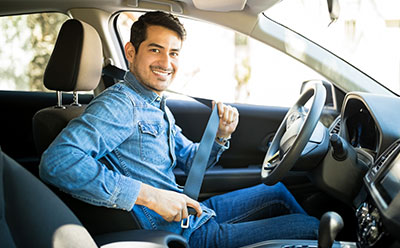
Buckling your seatbelt isn’t the only way to protect yourself while driving. The type of car you drive — and its vehicle safety features — can influence how safe you are in the event of an accident. Advances in automotive technology mean more safety features are available in new cars than ever before.

However, some of the technology that helps make driving safer today may include things you can’t readily see when you walk the lot and “kick the tires” to check out a new vehicle. Let’s look at some safety features to consider when buying your next automobile.
Advanced Crash Protection
Vehicle safety standards are mandated by the federal government, including advanced crash protection which consists of structural features, restraints and airbags. Although airbags became mandatory for all passenger cars, light trucks and vans in 1999, there’s a lot more to consider when looking for a safe vehicle.
The Insurance Institute for Highway Safety (IIHS) performs crash tests on vehicles and rates their performance.1 The tests have become more rigorous over the past decade — giving drivers clearer, more meaningful insight into vehicle safety.
Although airbags are required, the current federal mandate only calls for two front-seat airbags. Most new cars have at least six airbags, and some offer as many as 10. According to IIHS research, in frontal crashes, front airbags reduce driver fatalities by 29%.2 In driver‑side impacts, side airbags equipped with head protection lower the risk of driver death by 37%. The protective benefit is even greater for SUV drivers, where head‑protecting side airbags reduce the risk of death by 52% in driver‑side crashes.3
Automatic emergency braking
Using radar sensors mounted on the front of a vehicle, automatic emergency braking (AEB) can detect a potential collision and alert the driver to avoid it. Additional IIHS research demonstrated that AEB alone can reduce rear-end collisions by 50%,4 and AEB with pedestrian detection can reduce pedestrian crashes by 27%.
Nearly all new vehicles include some form of AEB, but some of these systems seem to struggle in the dark. However, systems on new vehicles have been improving in nighttime performance5 since IIHS began testing vehicles for pedestrian crash prevention in the dark.
» Tip: It can be confusing when shopping because automakers use different names for this technology. But looking at the IIHS vehicle ratings6 can help you make an informed decision.
Blind spot monitoring and rear cross-traffic alert systems
This feature detects and warns of approaching traffic in blind spots on the rear quarter of the vehicle to increase your response time — and hopefully avoid a collision. Blind spot detection has been shown to reduce lane-change crashes by 14%.7
The warning can be visual, such as flashing lights on the vehicle’s A-pillars (the pillar between the windshield and either front door), as well as the rearview or exterior mirrors. Some vehicles include an auditory warning, making a sound to alert you that there’s something in your blind spot. If your car has a haptic steering wheel or driver’s seat, you might even feel a buzz or vibration to give you a heads-up.
Blind spot monitoring is often connected to a rear cross-traffic alert that warns a driver when it detects traffic crossing — including pedestrians — behind the vehicle when backing up.

Forward collision warning
Already offered on several mainstream vehicles as standard equipment, forward collision warning (FCW) uses a combination of cameras, radar and lasers to detect vehicles or objects in front of your car, SUV or truck. It gives a warning that may be visual, audible, tactile or a combination to alert you — and hopefully help avoid a collision.
Newer FCW systems are tied to the AEB systems mentioned above, precharging the brakes to maximize their effectiveness. Most FCW systems also apply the brakes if the driver doesn’t respond.
Lane technology
Lane-departure technology monitors the vehicle in relation to lane markers — the center and side stripes on roadways. It gives a warning if it senses your car is veering into another lane. More advanced systems will nudge the vehicle back into the lane.
Lane-keeping assist is a more sophisticated version of lane-departure warnings. Beyond the nudge of the warning system, it uses the steering to keep the vehicle in the lane. And while the force won’t overpower your input, it gets your attention. Recognizing its potential to avoid crashes, leading safety organizations like the NHTSA now include lane-keeping assist in their vehicle safety ratings.8
Lane-centering assist (LCA) goes a step beyond lane-keeping by taking a more active role in keeping your car centered in the lane. In some cases, LCA is only engaged when using active cruise control.
Automatic crash notification
Some safety features are designed to help in an accident’s aftermath. Automatic crash notification systems alert first responders if a crash is detected or if air bags have deployed, sending the vehicle’s GPS location so assistance can be provided. While automakers have charged a fee to subscribe to the service in the past, a growing number are now offering it free on new vehicles.
The takeaway
Increased safety features may help prevent accidents or reduce injuries when a collision happens. Before purchasing your next new vehicle, it’s good to know what features to look for to help keep you and your family safe.
Of course, it helps to have the auto insurance you need, too. RBFCU Insurance Agency can provide a policy review or you can request an online quote today.